
Hello Deer
I’ve had a few new visitors to my blog recently, so I just wanted give you a warm welcome to my website, and also to introduce my local patch, where I do a lot of my photography – Redgrave and Lopham Fen.
Redgrave and Lopham Fen is the largest remaining valley fen in England, and managed by Suffolk Wildlife Trust. The reserve encompasses not just fenland, but woodland and heath too. It’s a peaceful haven for me, having lived in the area for around 20 years I’ve grown up here, walking the tracks that criss cross the reserve and watching the amazing wildlife. For the wildlife, this place is an oasis in the agricultural vastness of the surrounding fields. The river Waveney rises here, although there’s not much to see at it’s source, just a boggy area and flooded scrape patrolled by Grey Herons, and dabbled by Teal in winter.
There’s something to see year round, but winter is a favourite time to visit for me, the frost crystallised on the reeds and clear cold sky, and often I have this tranquil place to myself. This morning I paused to watch a group of Long-tailed tits foraging in the brambles, and when I walked a little further a movement ahead made me stop. It was a Roe deer, the youngster from the group of three I photographed earlier in the week, she was so close, and hadn’t yet noticed me. Carefully and quietly setting up the camera, I waited and watched, fully expecting her to sense me and bound away, but in the cold still air she couldn’t smell me, and maybe if I stay still she won’t see me. She turned, nibbling on bramble leaves, and focussing manually for quietness and the distracting branches, I took her picture.
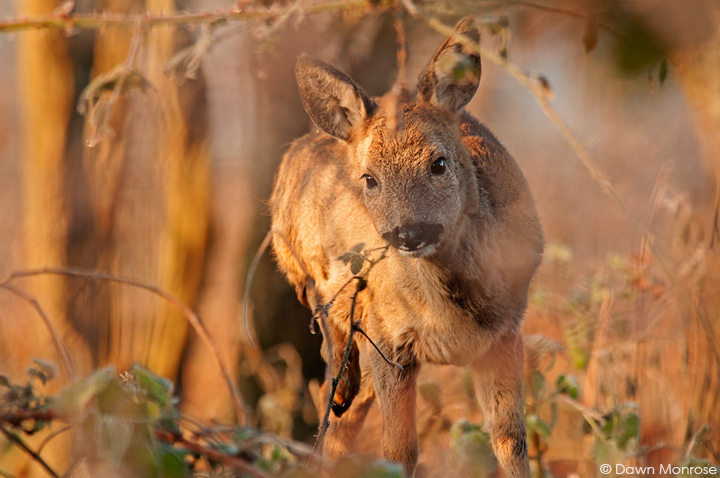
Roe deer have to be my favourite deer species, such elegance and grace, and such a privilege to observe one so closely. Amazingly the sound of the camera shutter didn’t spook her, and she started to move towards me. Just the other side of the brambles, just a few meters away. So close I could hear each dainty hoof-step on the frozen leaves layered on the ground. She passed by, and waiting until she had moved off, we went our separate ways.
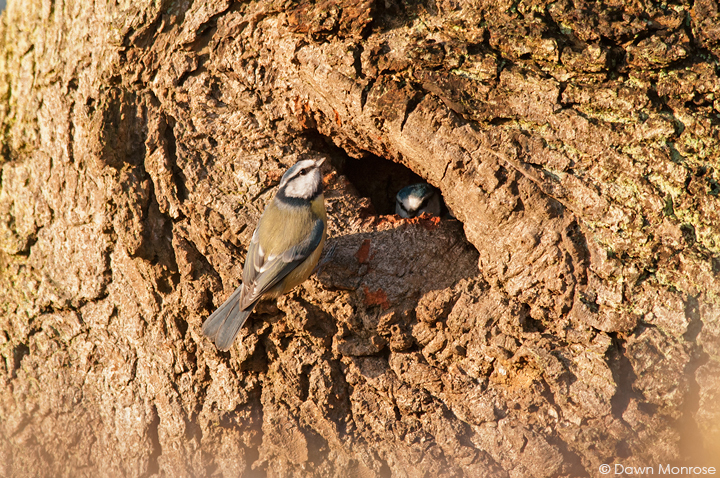
The birds were very busy, and despite the fact it’s only January a pair of Blue tits were investigating a potential nest site. A tantalising glimpse of spring.
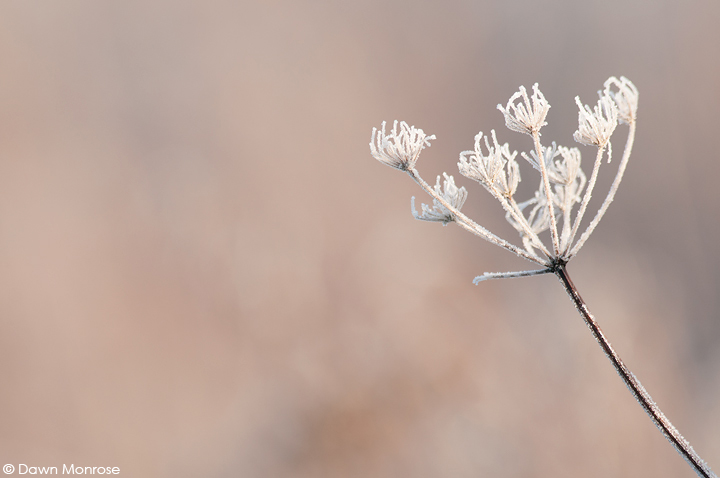
The Bearded tits whizzed across the path, not pausing for a photo today, but as ever, lovely to see. Walking back, a reminder that it is still winter, a dried umbellifer sparkling with the frost.
I noticed a Fieldfare paying close attention to a Molehill, and after a few moments I realised why – the mole was busy rearranging his home, pushing soil up to the surface and no doubt insects or worms too, hence the attraction to the Fieldfare. Short video here: Mole in the Molehill.
(Click images to view larger…)
If you like what you see, please consider sharing![social_share/]

Follow me on Facebook: https://www.facebook.com/DawnMonroseNaturePhotography
Current favourite books, click for more info:
  |   |   |
Lovely shots and narrative.
Such lovely crisp images, I particularly like the blue Tits pic, a very intimate shot.