
Spot the bird
Wildlife photographers have a habit of showing only their very best work, which is of course understandable. It does leave aspiring wildlife photographers a little disillusioned or disappointed with their own efforts, because it’s a fact that for every amazing photo taken, there’s ten, twenty, or a hundred (or more!) ‘misses’. After all, we’re dealing with living beings which move, run or fly away, and refuse to look in the right direction. Sometimes, we go out to shoot, and come away totally empty handed, which is why patience and persistence is key to nature photography.
Today was nearly one of those days. Over on the fen this morning, bright but incredibly windy. In the shelter of the hedgerow, a twittering flock of small birds were feeding, Long-tailed tits, Blue and Great tits, a Robin, and several cryptically camouflaged little birds. Can you spot the bird in this photo?
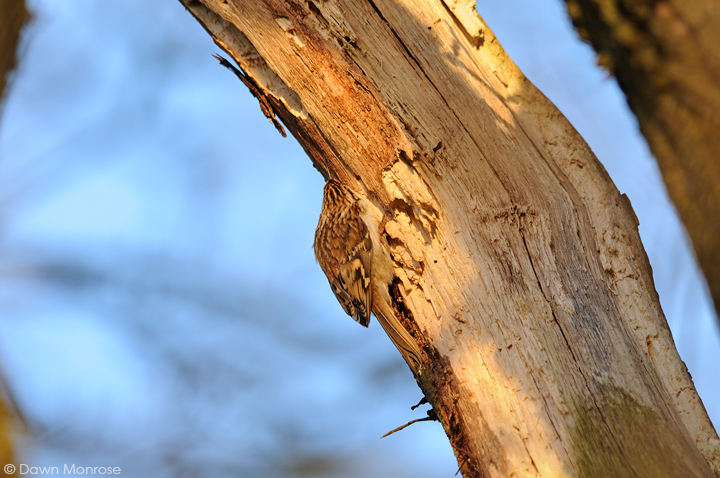
It’s a Treecreeper, fascinating little birds that creep up the trees, checking every crack and crevice for insects, using their curved needle like beak to extract their quarry and their long, stiff forked tail as a prop to help them cling to the bark. They are constantly in motion with tiny mouse like movements, making them extremely difficult to photograph. This one refused to look at the camera, but does nicely illustrate just how well camouflaged they are, and also my point about the frustrations of wildlife photography!
Walking on to see if I could spot the Bearded Reedlings, I was faced with a sea of swishing reeds, swaying violently in the swirling wind, and I knew it was unlikely I would see them. After an hour of waiting I heard a few pinging calls, but didn’t see the birds.
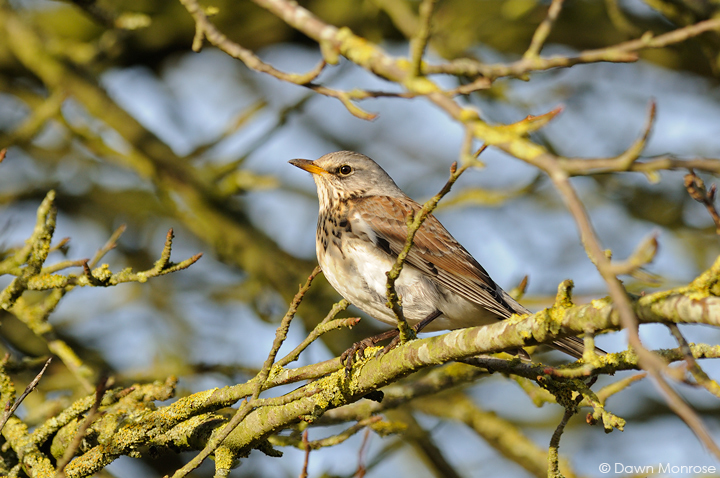
Heading back to the warmth of the hedge line, I spotted one of the Fieldfares perched so attempted a stealthy approach. Fieldfares are one of our wonderful winter visitors, a beautiful thrush species, they are closely associated with orchards, feeding on the fallen apples, and may also be seen feeding on berries in the hedges. On the fen they seem to pay close attention to the dry mole run riddled areas, perhaps taking advantage of the worms and insects bought to the surface here. This one was surprising tolerant and allowed me to photograph it as it sat in the hedge.
(Click images to view larger…)
If you like what you see, please consider sharing![social_share/]

Follow me on Facebook: https://www.facebook.com/DawnMonroseNaturePhotography
Current favourite books, click for more info:
  |   |   |
Lovely pictures and thanks for the encouragement as I always seem to miss the best shots.
Such clears pics – you would certainly miss the treecreeper if it wasn’t moving!
Really sharp images, I like the way the fieldfare seems to be looking right at the camera. The tree creeper is very well camouflaged. I did have the privilage to see one once on the silver birch in my garden.