
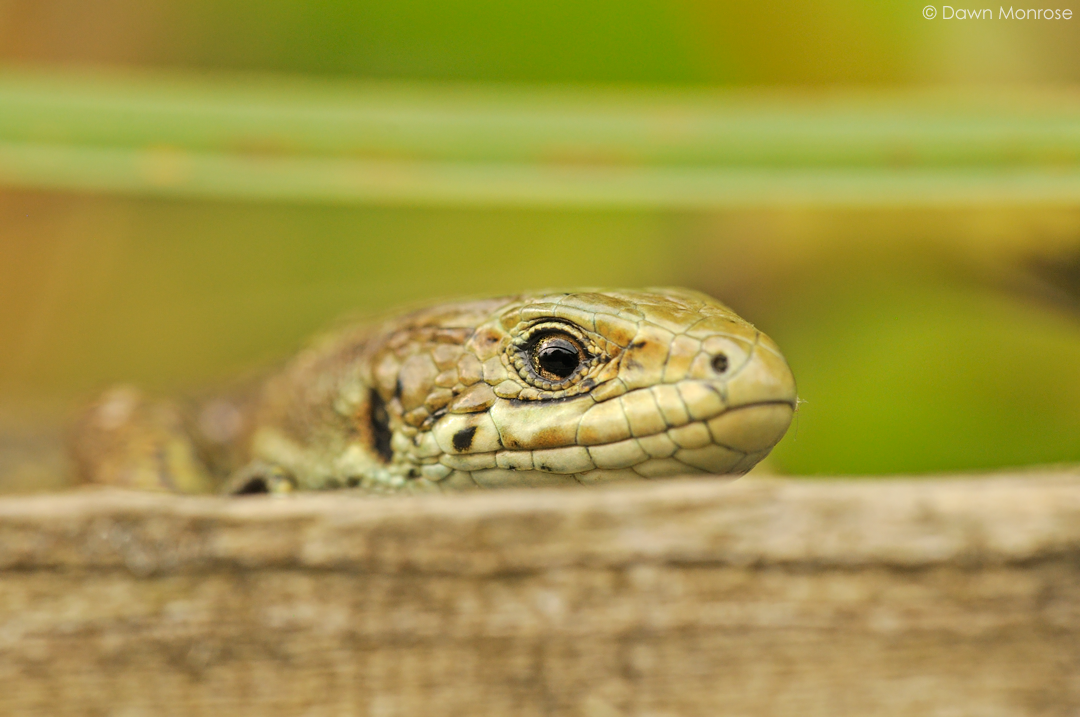
The Littlest Dragon
Ok, I admit it. Lizards. My favourite species to photograph. Don’t get me wrong, I love the hares and the barn owls too, but lizards, so full of character, so fascinating in their little macro world. It absorbs me, my attention, I could spend hours watching, yet to me feels like barely a few minutes.
I’m watching one now, well I’m trying. The gravel path is fighting against me. A slow approach is best. Lizards have different characters, some bold or calm, some skittish, and it depends on the weather too. This one is relaxed, so I edge closer, wincing in pain as my elbow meets yet another stone. I shift position slightly to avoid it, finding an even sharper stone in the process. Ouch. I glance down to try and find a more comfortable patch. When I look up she’s looking at me curiously over the edge of the wooden plank that she was basking on.
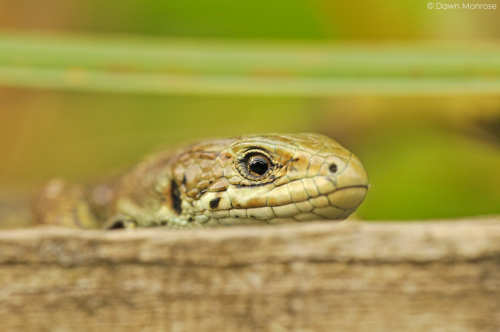
They may be scaly, but to me they are beautiful. They make me think of dinosaurs and dragons, yet could fit in the palm of my hand. It amazes me that we could have something so seemingly exotic living in our rainy little country. They radiate an ancient intelligence, I know she’s watching me, just as I am watching her.
She holds me steady in her golden gaze, observant, curious, not scared. An ant scuttles by, running right over her tail, she flinches but makes no move to catch it. Perhaps ants are too spicy. A fly buzzing above grabs her attention, she lifts her head and tracks its flight path. Moving stealthily through the grass, to me mere wisps, but to her they are tree trunks and branches.
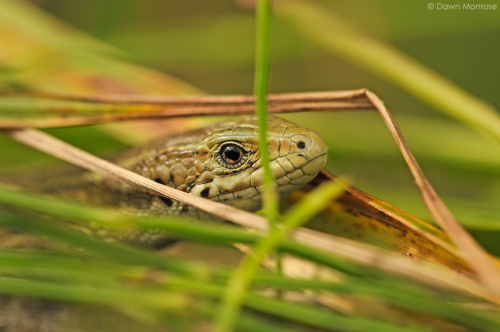
She’s well camouflaged, but the fly darts away, so she resumes her basking, and I leave her to it. The littlest, prettiest dragon you could find.
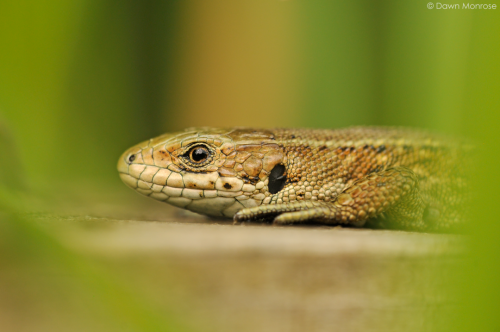
The common or viviparous lizard is one of just three native lizards found in the UK, the others being the slow worm (a legless lizard) and the sand lizard (incredibly rare and threatened). The common lizard ‘gives birth’ to live young after incubating its eggs inside its body, an adaptation for our cooler climate. They grow to around 10-15cm in length, the males more highly patterned than the golden coloured females or darker youngsters. They can be found in a variety of habitats such as heathland, grassland and woodland. This individual was photographed at RSPB Strumpshaw Fen, where they can be regulary spotted along the path edges.
https://www.rspb.org.uk/reserves-and-events/reserves-a-z/strumpshaw-fen/